
While Pakistan is estimated to possess 70-90 nuclear weapons, India is believed to have 60-80, claims Robert S Norris and Hans M Kristensen in their latest article 'Nuclear Notebook: Worldwide deployments of nuclear weapons, 2009'.

Prime Minister Narendra Modi's 'dimagi Naxal' (intellectual Naxal) remark, made during his Independence Day address, has ignited a significant political debate, with Union Minister Kiren Rijiju clarifying that the comment targets those who support Maoists and separatists, not opposition leaders, while opposition figures like P Chidambaram have embraced the label in defiance.

United States President Donald Trump and Iranian President Masoud Pezeshkian have virtually signed a 14-point memorandum of understanding (MoU) to end hostilities, reopen the Strait of Hormuz, and begin a 60-day negotiation process on sanctions and Iran's nuclear programme.
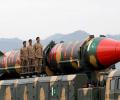
India responded to US President Donald Trump's comments regarding Pakistan's nuclear weapons testing, highlighting Pakistan's history of nuclear proliferation and illegal activities.

Newly declassified documents from the United States National Security Archive have revealed that Pakistan's nuclear proliferation was a significant concern for both the US and Russia, with leaders expressing 'nervous' fears about the country's atomic stability.

US President Donald Trump stated he would not set a deadline for ending the conflict with Iran, claiming Iran's military capabilities have been severely weakened. He also said he would not use nuclear weapons and maintained the US has complete control over blockade measures against Iran.

Declaring that they consider the avoidance of war between Nuclear-Weapon States and the reduction of strategic risks as their foremost responsibilities, the leaders of the five countries in a joint statement said, "we affirm that a nuclear war cannot be won and must never be fought."

US President Donald Trump announced he halted planned military strikes on Iran following requests from Qatar, Saudi Arabia, and the UAE, citing ongoing discussions that could lead to a deal.

"The recent arrests here in our own country trace back to Pakistan and trace back certainly in the case of Zazi, directly to an Al Qaeda-originated training camp and training programme. But finally and perhaps most chillingly the fact that Pakistan is a nuclear power raises the stakes enormously," she said.

In a development that could reshape West Asia's security landscape, US President Donald Trump announced Friday that he will convene an emergency meeting in the White House Situation Room to make a final decision on a broad, multi-part peace deal with Iran.

United States Defense Secretary Robert Gates has claimed that Iran has every intention of developing nuclear weapons. In an interview with ABC aired on Sunday, Gates added, "The question of whether they have made a formal decision to move towards the development of nuclear weapons is in doubt."

The United States and Iran have reached an agreement in principle to immediately and permanently halt all military operations, lift sanctions, and work towards a comprehensive final agreement within 60 days, including a significant reconstruction package for Iran.
The ultimate goal of the United States and its international partners is to prevent Iran from acquiring nuclear weapons, United States Secretary of State Hillary Clinton has said.

US President Donald Trump has claimed that Iran's missile capabilities have been severely degraded, saying Tehran now possesses only a fraction of the arsenal it had before recent hostilities.
The United States, on Tuesday, denied reports that it has plans to seize Pakistan's nuclear weapons, saying it has confidence on the ability of Islamabad to provide adequate security for their atomic arsenal.

'Pakistan's is the only military-controlled nuclear weapons programme in the world.' 'As people get radicalised, the risk of a brigadier or pilot taking matters into their own hands is a real concern.'
We bring forth to our readers the list of nations sitting on a nuclear stockpile, based on the study findings:

US President Donald Trump revealed he was on the verge of ordering attacks on Iran but postponed the decision after receiving calls from Qatar and the UAE, citing progress in peace talks.

'The position of Karachi depicted at that time and the intense rivalry among the factional overlords in Lyari is very close to reality.'

Israel's Defence Minister Israel Katz has stated that Israel is prepared to escalate military action against Iran, pending approval from the United States. This comes as US President Donald Trump says he would not use nuclear weapons in any conflict with Iran, while also claiming the US has 'total control' over the Strait of Hormuz.

US President Donald Trump has stated that the war with Iran is "close to over," while the US Central Command reports blocking traffic to Iranian ports.
.jpg)
India, along with the United States and Pakistan, has voted against a provision in a United nations resolution calling on to 'promptly' accede to the Non-Proliferation Treaty as non-nuclear-weapon nation 'without conditions' and to place all its nuclear facilities under International Atomic Energy Agency safeguards.

Former US President Donald Trump claimed victory over Iran, stating they agreed to never have a nuclear weapon and provided a 'significant prize' related to the Strait of Hormuz. He also suggested a change in Iranian leadership and acknowledged Pakistan's role in facilitating talks.

Head of the Iranian Parliament's National Security Committee Ebrahim Azizi on Saturday said that Iran has prepared a "professional mechanism" to regulate maritime traffic in the Strait of Hormuz through a designated route, which will be unveiled soon.

US President Donald Trump in an exclusive interview to Axios on Wednesday, said that he would continue to keep the naval blockade until Iran agrees to deal with the United States by addressing America's concerns about the nuclear programme.
The nuclear arms race between India and Pakistan has figured during a Congressional hearing on the New START treaty between the United States and Russia.For the past two days, during hearings on the New START treaty held by the Senate Foreign Relations Committee, lawmakers wanted to know from top US officials and experts about other nuclear weapon countries like India and Pakistan and how it can motivate the two countries to reduce their nuclear stockpile.

US President Donald Trump on Monday doubled down on his hardline stance against Tehran while dismissing mainstream media narratives regarding his foreign policy motivations.

Amidst rising tensions, Iran threatens to close the Strait of Hormuz to those not adhering to its new regulations, signaling a potential escalation in the region's geopolitical landscape and raising concerns about global oil supply routes.

US President Donald Trump's proposed peace deal with Iran has drawn significant criticism from both Republican and Democrat senators, who express deep concerns that it would legitimise Tehran as a 'dominant force' and potentially allow it to retain control over the Strait of Hormuz and uranium enrichment capabilities.
The United States, Russia, United Kingdom, France, China, India, Pakistan, Israel and North Korea possess approximately 16,300 nuclear weapons collectively. A glimpse of nine countries with nuclear weapons.

The US assessment of nuclear weapons security in Pakistan appears to have changed considerably from confidence to concern, particularly as a result of the introduction of tactical nuclear weapons, the report said.

A US-Iran memorandum of understanding is set to be signed, outlining sanctions relief, the reopening of the Strait of Hormuz, and a 60-day negotiation window for Iran's uranium enrichment, but US President Donald Trump has underscored the deal's conditional nature, warning of military action if Tehran fails to comply.

US Vice-President J D Vance's unexpected phone call to Prime Minister Narendra Modi on August 8 has ignited speculation about a potential diplomatic overture, possibly seeking India's support amidst the escalating US-Iran conflict and a shifting global power landscape, suggests Ambassador M K Bhadrakumar.

US Vice President J D Vance stated that while progress was made during peace talks in Islamabad, it is now up to Iran to further the discussions and address US concerns regarding its nuclear ambitions.

US President Donald Trump has claimed that China has committed to halting weapon supplies to Iran, following his personal diplomatic interventions with Chinese President Xi Jinping.

Iranian media reported an exchange of fire between Iranian and US forces near the Strait of Hormuz, amidst a shaky ceasefire between the two countries.

Donald Trump is claiming he prevented a war between India and Pakistan, a statement that has been repeatedly made by the former US President despite denials from India.

Pakistan's Defence Minister Khawaja Asif said that India was waging a proxy war against his nation trough terrorism.
"Pakistan's jump from an estimated 60 to 110 nuclear weapons is unlikely to shift the balance of power vis a vis India," said Alexander H Rothman and Lawrence J Korb from the Centre for American Progress in their analysis of the recent news reports that Pakistan's nuclear arsenal.
Warning that the Al Qaeda wants a nuclear weapon not to build a stockpile but to use it, a senior US official has said that the terror group will use only a handful number of operatives to carry out the attack, just as they did during the 9/11 strikes. An Al-Qaeda nuclear attack would be in the planning stages at the same time as several other plots, and only the most senior leadership of the terrorist outfit will know which plot will be approved.
